
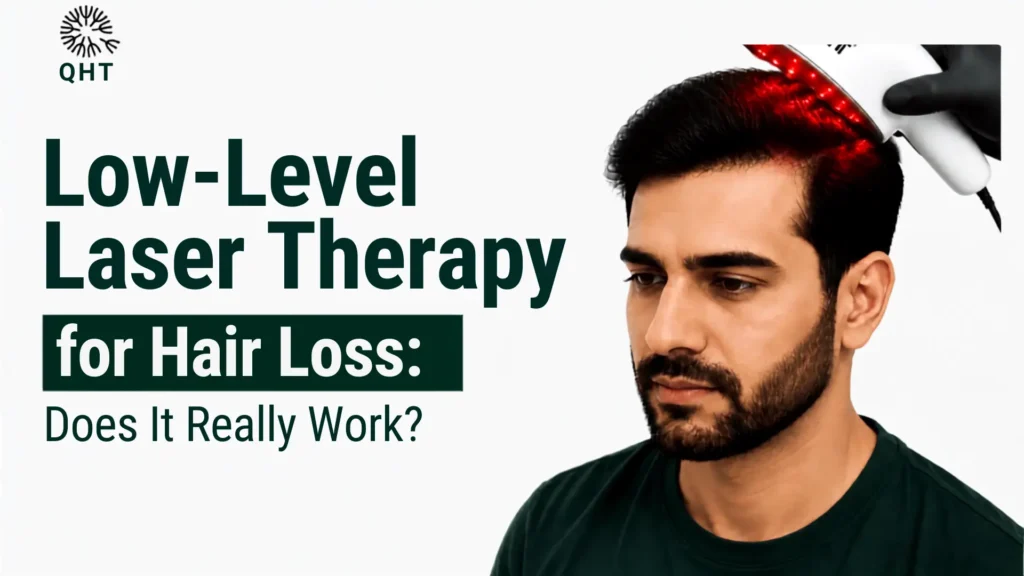
Yes, that is right. Low-level laser therapy used to be marketed in an alternative approach to thinning hair, now it is recognized as a medically proven, non-surgical solution, whereby ‘light from special frequencies may stimulate inactive follicles and encourage new hair to grow. It doesn’t burn or incise the scalp-rather it energises dormant cells at the follicle.’ Results are different for individuals, but there are many studies that may lead you to think of using LLLT for some types of hair loss.
What Is Low-Level Laser Therapy for Hair Loss?
This therapy, also referred to as red light or photobiomodulation, is done using a diode laser or light emitting diodes (LED’s). These diodes or LEDs are designed to emit weak power into the scalp’s hair follicles at wavelengths ranging roughly between 630 and 670 nanometers. These light wavelengths don’t cause heat or damage when reaching the root underneath.
How the low-level laser works:
i) The light energy gets into the cell of the follicle.
ii) The cell uses the energy to produce additional ATP (adenosine triphosphate), which is energy to power cellular activities, and the cell uses adenosine triphosphate (ATP) inside the mitochondria, the power unit for the cell, to develop new energy.
iii) Follicles become stimulated. The damaged or resting ones go back to an active stage of producing hair once they have adequate energy.
iv) Blood supply around the follicle increases, delivering oxygen and necessary nutrients directly into the root.
This method can help reduce both male and female pattern baldness( androgenetic alopecia), diffuse thinning stemming from stress, and hormonal change.
What Forms Does LLLT Come In?
There are various types of LLLT devices to accommodate in-clinic and home use:
1. Laser caps and helmets: applied to the head and worn for a prescribed amount of time, full scalp covered.
2. Laser combs and bands: handheld devices used by the patient to run over thinning areas.
3. In-clinic laser panels: much stronger and full scalp than handhelds, and used by specialists.
In-clinic devices are much stronger than home use and often have greater or faster or more consistent effects.
Does the Research Actually Support It?
Yes – although with one caveat or another:Several research papers showed statistically significant increases in hair density and thickness for people treated with LLLT consistently. The FDA approves a few different LLLT treatments to be used to encourage hair growth for both men and women for hereditary loss. This isn’t a wonder treatment, though; here’s what the science actually says:
i) LLLT works best on already struggling but alive hair follicle– not a completely dead one
ii) It takes time to see results; most find a significant difference between 3-6months of using it consistently
iii) It works really well to supplement other hair loss treatments including minoxidil, PRPs, and after a hair transplant surgery
iv) The level of density you can achieve will likely not compare to what you get from hair transplant surgery.
Who Is LLLT Best Suited For?
But what doesn’t LLLT work for? Here is a list of who’s more likely to achieve good results:
i) Someone who is experiencing early-to-midstage hair loss.
ii) Someone experiencing diffuse loss rather than large patches of baldness.
iii) Someone who is seeking a surgical or chemical-free approach.
iv) Someone using other recognised and established treatments alongside LLLT.
V) Someone seeking maintenance following a hair transplant procedure.
For people whose hair loss has reached the stage where the follicle itself has died in specific areas, LLLT would be ineffectual. Surgical intervention would be a more effective path.
LLLT vs. a Hair Transplant: What Is the Difference?
That is exactly what patients are wondering about in a hair transplant clinic in Hyderabad. The key difference between both treatment options is Permanence LLLT is for anyone with slow loss, it helps the stopping, and makes their thinning hair may grow denser. All you want, in contrast, will have to adhere to it regularly.
On the other hand, hair transplants designed to permanently place Hair with their resistance to hormones that have caused patterned baldness(DHT resistance hair transplantation).
Those hairs, which are taken from the back of our head where there is enough hair thickness, will be permanently resisted against hormones. Thus Hair Transplant does offer permanent results. Therefore If the hair lost is nascent, you can use LLLT to maintain the hair for few years in the area of loss,But if it has passed beyond and the hair losses are in a high stage,hair transplant the more sustainable way to addressHair loss issues is one is able to carry out your desires of an enhanced hair style.
Can LLLT Be Combined With Other Treatments?
Yes, in fact for many patients this is actually desirable. LLTT may be applied combination with:
i) PRPT, so the follicular activity may be stimulated even more
ii) Minoxidil application so as to extend anagen hair phase
iii) After hair transplantation surgery so as to accelerate graft healing and early growing out.
Many clients of a dense hair implantation clinic in Hyderabad try LLTT in postoperatively months to accelerate the healing and optimize density in the grafted region.
Final Word
Low-Level Laser Therapy (LLLT) is a proven treatment that stands its own for those in the earlier stages of hair loss and for those seeking an add on to their hair loss treatment. It’s a safe and painless treatment with no known side effects. However, it is far from a ‘fix-all’ for extreme hair loss.
If you’re not certain of what’s the correct treatment approach for your hair condition, whether LLLT, transplants or the combination of treatments, it’s always prudent to see a doctor first.
QHT Hyderabad provides detailed hair loss evaluation for patients not just from India but internationally. Whether you are considering LLLT as part of your treatment or a transplant in the future – visiting us as a Hair Transplant Clinic for International Patients regularly – our experts will assist you in finding the best solution in the most practical and ethical way.

