
One of the most popular questions we get asked here in our hair restoration clinic is regarding vertices – a hair loss hair at the crown of the head. If you’ve been asking, “how can I regrow hair at the crown of my head,” you’re in luck – there are proven answers for how you can help treat your crown. This article will tell you exactly why crown hair loss occurs and how you can potentially regrow your hair on your head’s crown and when a hair transplant is the next step.
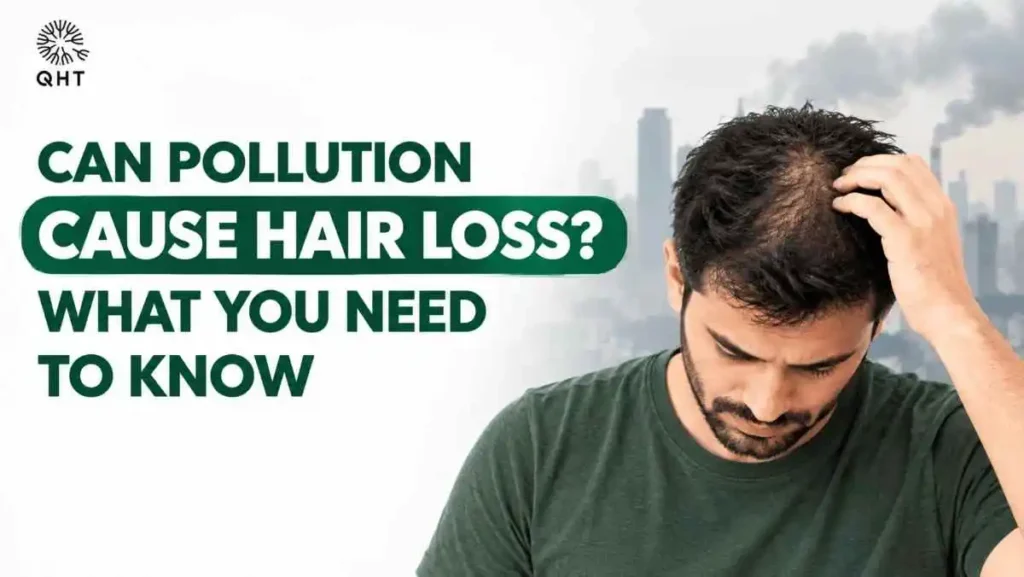
How Does Pollution Affect Your Hair and Scalp?
And your scalp is skin – and skin is, after all, in direct contact with the world around us. When it is exposed to polluted air it get in with these four chemicals:
(i) Particulate matter (PM2.5 and PM10) – all those tiny particles that can sneak into your hair follicles and disrupt the hair’s natural growth pattern.
(ii) Polycyclic aromatic hydrocarbons (PAHs) – those chemicals that are released into the air from exhaust fumes and manufacturing plants that have been shown to inhibit growth at the cellular level of hair follicles.
(iii) Heavy metals (lead, arsenic, and mercury) – These metals build up in the tissue of the scalp and interfere with cell functions necessary for hair follicles to do their thing.
(iv) Sulfur dioxide and nitrogen oxides – gaseous molecules that react with water in the scalp’s tissue to produce slightly acidic conditions that do more damage to the hair shaft and break down follicles.
Does Pollution Cause Hair Loss Differently Than Other Triggers?
This makes it a vital point: pollution is the outside attack, but nutritional deficiencies, hormonal imbalances, physical and mental stress are the inside ones. And only the outside attack can be fought with external solutions. For we have known for decades that oil-based pollutants don’t make it to the follicle, but other components of the air do: a study from 2019 published in the Journal of Investigative Dermatology found that common air pollutants decreased follicle-cell protein levels important for follicle functioning and hair retention by up to 70%.
In short, if pollution-related hair fall is more than just an interesting concept, it is a clinical reality.
The problem is that pollution-related hair fall is particularly difficult to solve because it doesn’t happen on its own:
(i) It causes dandruff and seborrheic dermatitis which weaken the follicle.
(ii) It causes an increase of oxidative stress that accelerates androgenic hair loss (pattern baldness), and
(iii) It inhibits the scalp’s ability to absorb the nutrients needed to maintain its optimal functioning.
Who Is Most at Risk?
Contrary to what you might think, the worst pollution levels are experienced by people living in huge urban and suburban areas where there is high density of cars and industry. Hyderabad, Mumbai, Kolkata and Kanpur are therefore among the 20 worst polluted cities in the world. Hair fall due to pollution is therefore a reality for most people in these cities. The risks therefore of pollution damage to the hair are;
i) People who spend the maximum amount of time outdoors, thanks to their work environment or commute
ii) People who are at the greatest risk of pattern hair loss or thinning hair thanks to their genetic history
iii) People who have a scalp condition that lowers their skin barrier
iv) People with a stressful, busy lifestyle thanks to increased internally generated oxidative stress teamed with an external pollution load.
What Can You Do to Protect Your Hair from Pollution?
This is what will help! Daily hair rinsing and scotch spray protection:
i) Wash your hair more often than not—not always, though! One of the best and least expensive ways to protect yourself is to wash those pollutants away before they even start thinking about sticking to your scalp.
ii) Use a vitamin E serum or oil to condition and protect your scalp, as this is a state-of-the-art antioxidant to prevent damage from all the oxidative stress i.e. pollution.
iii) Cover your head. As ordinary as it may sound, but if you cover your hair with a bonnet, scarf or cap before stepping out into the sun, you’ll be doing a lot of good!
iv) Decreased consumption of heavily processed calorie-dense products and eating more fresh produce containing vitamin C, E, zinc, and omega-3s-that’s right, they’re good for your hair too!
v) Ensure adequate water intake and hydrate your scalp just as well, so your cells stay healthy, and you can repair some level of damage to the scalp’s skin barrier.
A healthy, thicker, and healthier scalp is all you need!
When Preventive Measures Are Not Enough?
By the time you are connecting the dots and discovering that your hair is falling because of the environment, it’s already irreparable. Whether it is a pattern thinning or a visible thinning at the crown or temple, and a reduction in density you notice, your follicles may be damaged by pollution over the years, and won’t respond to topical treatments. This is where clinical solutions come in.
If you are looking for a , you can go for several options available for you, whether it is PRP (Platelet-Rich Plasma) therapy or laser treatments or even hair transplants, depending on the level of loss and the health of the donor follicles.
A clinical specialist can only tell you exactly how much of your hair loss is driven by pollution vs genetics and can tell you what the course of action should be.
Conclusion: Yes, Pollution Does Cause Hair Fall—and It Deserves Serious Attention
Does pollution cause hair loss? Yes- a lot! It’s one of the most major, silent yet most unrecognised reasons for hair shedding in Hyderabad. The combined impact of particulate pollutants, chemical pollution and the oxidative stress that it causes on your hair follicles can be devastating. The bright side is that awareness is the first step to reversing the effect and there are options available at every level- right from daily protection of your hair to clinical interventions for hair fall in Hyderabad.
If your hair is falling at a quick pace and you are based in a polluted city, then don’t wait for it to get worse- your hair fall specialist at the best hair transplant clinic in Hyderabad will make you understand your condition and chart out your best options- be it through a medical non-surgical hair loss treatment plan or through a hair restoration treatment- such as a PRP Hair Treatment Clinic in Hyderabad, in the advanced stages of hair loss.

