
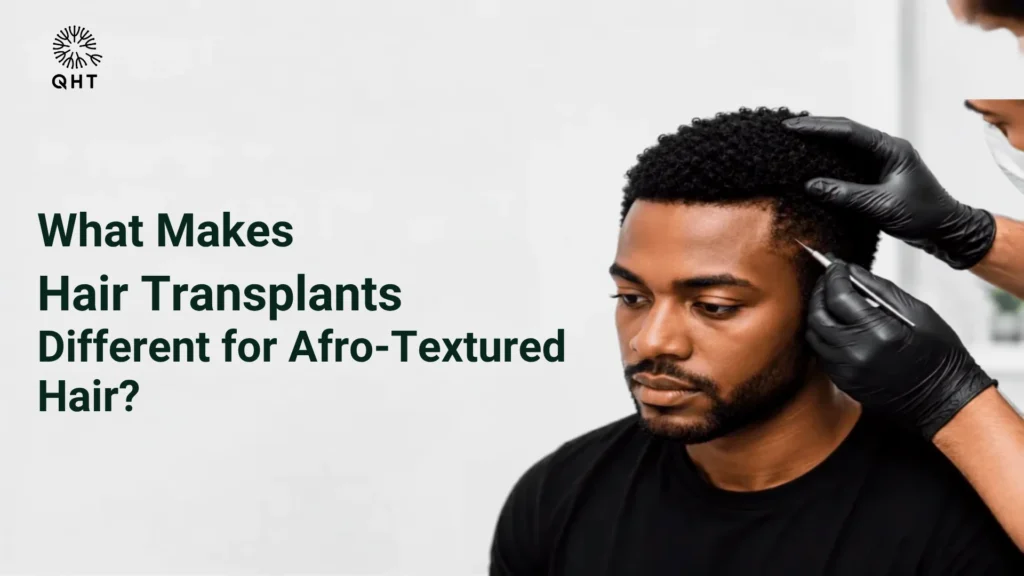
Afro hair transplants are quite different from regular hair restoration The characteristics of African hair – like the shape of their follicles, and the naturally coiling structure – necessitate a drastically different surgical technique. Whether you’ve decided that you want to have your tight Afro hair transplanted or you’re still thinking of your options, you must educate yourself about the procedure.
Why Afro-Textured Hair Is Unique?
This hair grows in a tight coil – this helical configuration doesn’t start at the level of the skin’s surface. The follicle’s own orientation within the skin is curved, and is at a sharp angle to your scalp’s surface. This is in contrast to straight and wavy hair where follicles are laid down at a relatively uniform angle.
Because of this, during an extraction, the surgeon needs to follow the exact, curved pathway of the hair follicle.
A small miss, and the follicle may be transected (severed), leaving it without viability. Hence Afro-textured hair transplants pose a greater degree of technical difficulty and require surgeons skilled in the intricacies of its extraction.
The Extraction Challenge: Why Standard FUE Needs to Be Adapted
Traditional FUE tools focus on the straight trajectory in which most follicles are grown. When the same tools are used for Afro textured hair, without modification, the risk of follicular damage is extremely high. Skilled surgeons adjust these issues in the following way :
i) Curve punches or an extraction tool that is angled to match the directionality of individual follicles are used
ii) Micro-sized punching is also utilized in order to avoid damaging the surrounding tissue.
iii) Extremely deliberate and extremely slow extraction is then required to safeguard the viability of the individual follicles.
iv) Under magnification, it helps the surgeon to trace the directionality of the curl beneath the surface of the skin, at each moment of extraction. FUE- the “hair transplant for African”
The FUSE (Follicular Unit Separation Extraction) process, utilizing magnified instruments and painstakingly separating each follicle, individually is ideal for Afro textured hair due to its low mechanical trauma for each follicle and very reduced transaction rates, unlike that of the traditional FUE technique with non-modified instruments for hair transplant for Africans.
Scalp and Skin Considerations
Factors Special to the Afro-textured Patient in Hair Transplant The skin of an Afro-textured individual also comes with issues that might need special precautions during a hair transplant in addition to the shape of their follicles:
(i)Propensity towards keloids: Raised scars often appear on the darker skin tones. Minimised and clean incisions will minimise risks for this
(ii) The flexibility of skin: Thickness in the scalp also affects where recipient pits may be situated and how well they will heal
(iii) Post-inflammatory hypopigmentation also is likely to appear with darker skin.
If the healing isn’t handled carefully, this will also result in problems. These issues will be largely unattended in the hands of a non Afro-hair transplant-experienced surgeon, leading to a preventable problem in hair transplantation. It isn’t merely a preference in case of where the patient will go; it’s critical in all cases.
Hairline Design: A Different Aesthetic Standard
What “natural-looking” means is also unique to the individual. When considering Afro-textured hair, natural hairline designs must consider that coiled hair and straighter hair frame the face differently. African textured hair generally yields greater volume and height so even minimal grafts may look very dense on.
The surgical hairline designs must take this into consideration when placing and distributing graft densities to suit the individual ethnically as well as naturally and artistically.
Templates for more straight textures are simply not workable for Afro-textured hair; its up to the eye of the surgeon to make that estimation.
What Results Can You Realistically Expect?
In the correct hands, performing Afro hair transplants correctly can provide fantastic and realistic looking results, where the characteristic tight coil of the hair can actually benefit the patient post-surgery, in that each transplanted hair will cover visually more skin area so even a fairly low number of grafts can look relatively dense with very good coverage. Most patients start to see new hair growth come through 3-4 months post-transplant, and full results should be seen 12 months post-surgery. The transplanted hair will grow at exactly the same curl as your own so is completely unidentifiable once it fills in.
Choosing the Right Clinic Matters More Than You Think
This is to make sure you choose the surgeon and clinic experienced in handling afro textured hair, as not all of them will do so on a first hand basis. Speak to the surgeon and ask for his success stories on patients who share similar hair quality as yours. Also, take a look at some before and after case studies.
Should you be in the southern part of the country, take assistance from clinics providing the best hair transplant in Hyderabad or consider having your procedures performed at good clinics who have an array of case studies with all types of hairs.
Also take into consideration the Hair Transplant Cost in Hyderabad and that of Hair Transplant cost in Bangalore for good comparison. Price factor is also largely dependent on the number of grafts needed or procedure employed as well as severity.
Conclusion
An afro-textured hair transplant isn’t quite like your average hair restoration procedure-it requires far more than the basics at each stage. From extracting follicular units in a curved shape; creating incisions with a keen awareness of keloid scarring; and designing a hairline that is appropriate for an ethnicity. Fortunately, in capable hands, such a procedure is a permanently natural result well worth the investment of time in planning. Do your homework; learn as much as you can; and never entrust your hair to anywhere but a specialist clinic.
Frequently Asked Questions About Afro-Textured Hair Transplants
1. Why is an Afro-textured hair transplant more difficult?
Afro-textured hair follicles often curve beneath the scalp, making extraction more challenging and increasing the need for specialised techniques and experienced surgeons.
2. Can FUE be performed on Afro-textured hair?
Yes, FUE can be performed on Afro-textured hair when the surgeon understands curved follicles and uses appropriate extraction techniques to minimise follicle damage.
3. How many grafts are needed for an Afro hair transplant?
The number of grafts depends on hair loss, donor density, and treatment goals. Curly hair can provide good visual coverage with fewer grafts.
4. When will I see results after an Afro hair transplant?
Initial growth may appear around three to four months, while fuller results develop gradually. Final results are commonly assessed around 12 months after surgery.
5. Does Afro-textured hair increase the risk of scarring?
Some individuals may have a greater tendency toward certain scar types. Careful surgical planning and proper aftercare can help reduce complications.
6. Will transplanted Afro hair keep its natural curl?
Yes, transplanted follicles generally retain their natural characteristics, allowing the new hair to grow with a curl pattern similar to the donor hair.
7. How do I choose the right clinic for an Afro hair transplant?
Choose a clinic with demonstrated experience treating Afro-textured hair, ask to review relevant patient results, and discuss extraction techniques during consultation.

