
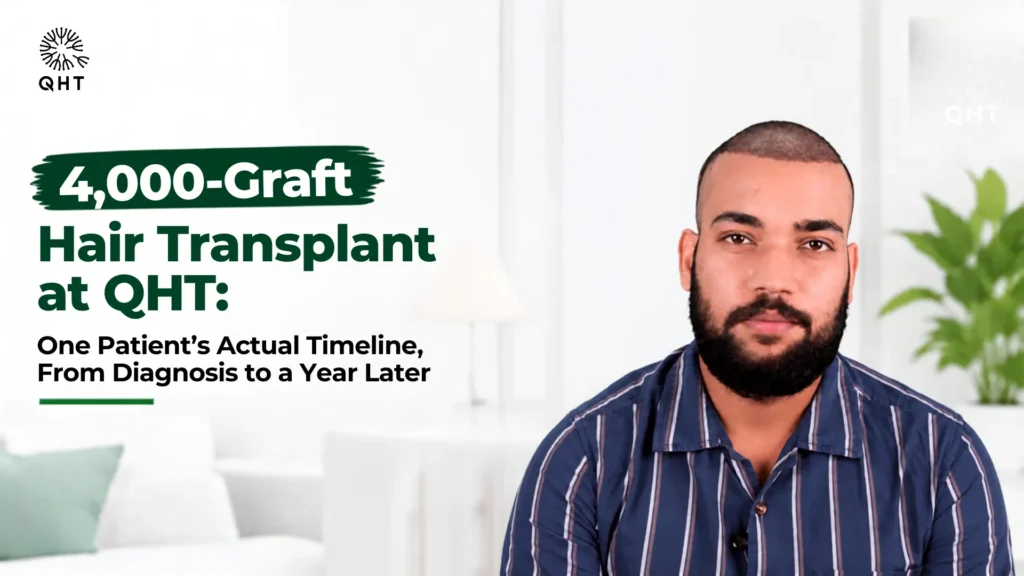
Nishan from Agra had been dealing with hair loss for about two years before he did anything about it beyond home remedies. That’s a fairly normal delay — most people try minoxidil, a few oils, maybe a dermatologist visit, before they seriously consider surgery. What eventually pushed him toward a transplant was the diagnosis: diffuse grade six baldness, with a receding M-shaped hairline and thinning spread across the scalp rather than confined to one spot.
He’d noticed the same pattern on both sides of his family, starting in his relatives’ early thirties. Once medication stopped moving the needle, he looked into transplant clinics and ended up at QHT after a friend pointed him to one of their videos.
What Actually Happens on Surgery Day?
The night before, the donor area gets marked and the incision plan is drawn up. Nishan showed up at the clinic around 7:30 AM after breakfast, went through the standard pre-op checks, and the procedure started with local anesthesia. He described the numbing injections as genuinely painful — not sugarcoated in his telling — but said he considered it worth it for what he was expecting to get out of it.
He had a little over 4,000 grafts placed using QHT’s own technique, which the clinic markets against FUE and FUT on two claims specifically: it’s faster, and it loses fewer grafts in the process. If you’re weighing that claim against a more established FUE hair transplant in Hyderabad, it’s worth asking any clinic you’re considering for their actual graft survival numbers rather than taking the comparison at face value — it’s the kind of thing that should hold up under a direct question.
Once the anesthesia kicked in, the rest of the day was mostly waiting — numbness at the donor site on the back of the head, a lunch break, a couple of bathroom breaks. Afterward, the team walked him through aftercare: saline on the grafted area, no touching it, and an antibiotic ointment to keep infection risk down while it heals.
The First Two Weeks Are the Strict Part
The instructions he was given weren’t vague. No gym for a full month. No direct sun. Two weeks of mostly resting at home. A month of prescribed medication. After the two-week mark, he was allowed out, but with a cap on to keep dust and sun off the scalp.
Another patient in the same set of interviews, two months out from his own surgery, called the procedure itself quick and close to painless — but even at two months he still hadn’t been cleared for a haircut, and he was already back for his first PRP session.
Why Everyone Keeps Mentioning the First 24 Hours?
It comes up again and again in these patient accounts: the first day after surgery is the one that matters most for keeping both the donor and recipient sites clean while the grafts are newly placed and most fragile. The bandage over the donor area comes off after that first 24 hours. According to the clinic, that site heals without leaving a visible line — which is the main thing that separates this from FUT, where a thin strip scar at the back of the head is a known trade-off.
Past that first day, patients are told to keep to a clean, closed environment for about two weeks, and to keep taking precautions — no heavy sweating, no direct sun — for the full month.
PRP Isn’t Optional, According to These Patients
More than one person in this series treated PRP as part of the deal, not an add-on. One patient, on her third session, said she’d recommend six or seven PRP sessions within the first year for better density. That’s a detail that’s easy to miss if you’re only budgeting for the surgery itself — the aftercare schedule, PRP included, is part of what actually determines how the result looks a year later.
How Long Regrowth Actually Takes?
This part varies more than people expect:
- Most areas start showing visible regrowth around 4 to 5 months
- The crown tends to lag behind — sometimes 6 months or more, since blood supply there behaves differently
- Full styling flexibility generally isn’t there until growth has settled past the 6-month point
One thing worth saying plainly, because the patients in this video said it themselves: a transplant works with the follicles available in your donor area. It creates the look of full density, but it isn’t a like-for-like restoration of someone’s original hairline. That’s a reasonable thing to bring up before booking a date, not after.
On Cost
Nobody in these interviews gave an actual number, which tracks — final pricing depends on graft count and technique, and it’s set after a consultation, not before one. What they did say was that the cost felt reasonable given the surgical team and facility. If you’re shopping around, get a graft-count-specific quote rather than comparing headline prices between clinics, since a 2,000-graft quote and a 4,000-graft quote aren’t comparable numbers to begin with.
Questions Worth Asking Before You Book
Based on what came up across these patient accounts, a few things are worth confirming directly with whichever hair transplant clinic in Hyderabad you’re consulting with, before you commit to a date:
- What’s my actual grade of baldness, and how many grafts does that realistically require?
- What’s the graft survival rate with this technique?
- What does the aftercare schedule look like — including how many PRP sessions, and over what period?
- What does donor-area healing look like — is there a visible scar or not?
- What’s a realistic, region-by-region growth timeline for a case like mine?
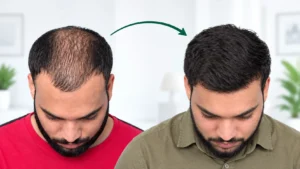
Nishan’s result — a natural-looking hairline he could style the way he wanted by the 12-month mark — came from a graft count that matched the severity of his baldness and an aftercare routine he stuck to closely, PRP sessions included. That combination, more than the surgery day itself, seems to be what decided how the year played out.

